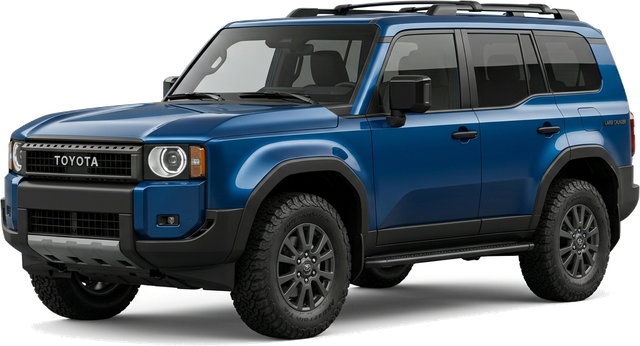
The real cargo dimensions, payload and clearances behind the seats of the Toyota Land Cruiser — J250, 200 Series and 100 Series — and exactly what overland gear you can load. Below is a to-scale 3D model of the cargo area, built from measured data.

Drawn to scale from measured cargo dimensions.
Measured cargo-area dimensions behind the second row of the J250 (2024–). Switch generations above — the 200 and 100 Series are shaped quite differently.
Dimensions are approximate and sourced from measured references — verify against your exact model year and trim before purchasing gear. Payload includes passengers and accessories; check your door-jamb sticker.
A realistic overland load against the J250's 499 kg (1,100 lb) payload budget — sized for an SUV cargo area.

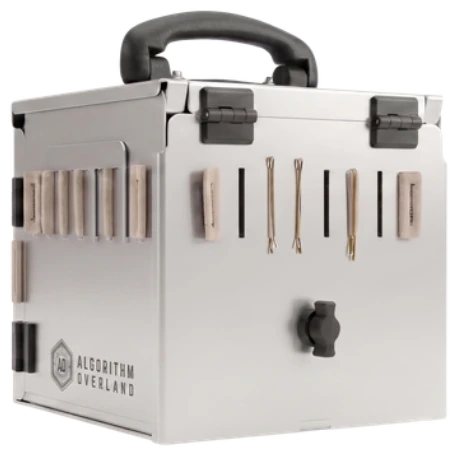
The Kitchen Cube is a modular, aircraft-grade aluminum camp kitchen that packs down to a compact 12-inch (305 mm) cube to live in your cargo area, and deploys on the tailgate.
Join the Waitlist →Exact fitment specs ship with the waitlist. Coming 2026.
Behind the second row: J250 (2024–) about 1105 × 1105 × 900 mm (43.5 × 43.5 × 35.4 in), roughly 1062 L (37.5 cu ft); 200 Series (2008–2021) about 885 × 1500 × 840 mm with an unusually wide 1390 mm floor; 100 Series (1998–2007) about 1168 × 1321 × 1067 mm.
About 499 kg (1,100 lb) for the J250, 615 kg (1,356 lb) for the 200 Series and 667 kg (1,471 lb) for the 100 Series — including passengers and accessories. Check the door-jamb sticker.
Yes — every generation here gives at least 885 mm of floor against 445–935 mm fridges. On the 200 Series the 1390 mm width means you can run a fridge and a drawer side by side.
Yes, with room — the 12-inch (305 mm) packed cube leaves about 595 mm (23.4 in) of height in the J250 and about 762 mm (30.0 in) in the tall 100 Series. Join the waitlist.